Skip to content

Voice Type Test Soprano, Alto, Tenor or Bass?

Sing from your lowest comfortable note to your highest and see which voice type your range fits, how much it overlaps each of the six main types, and which singers share it. Free, private and right in your browser.

  • Results in about a minute
  • Six voice types, soprano to bass
  • Audio stays on your device
Voice type test
Loading the tool…

How it works

How the voice type test works

Three steps and one slow slide through your voice. Find a quiet spot and keep your phone or laptop about an arm's length away.

  1. Step 1

    Allow the microphone and warm up

    Press Start and allow microphone access when your browser asks. Hum or sing a few easy notes first: a warmed-up voice usually reaches a few notes further at both ends than a cold one.

  2. Step 2

    Sing from your lowest note to your highest

    On an open "ah" or "oo", start at the lowest note you can hold without growling, then slide or step up slowly to the highest note you can sing without straining. Hold each note for a moment; that is what makes it count.

  3. Step 3

    Read your voice type

    You get your lowest and highest notes with their frequencies, the voice type your range fits best, how much you overlap each of the six types, and singers with a similar range. Run it again any time to compare.

Quick reference

Soprano, alto, tenor, bass: the six voice types at a glance

Typical classical ranges for each voice type, lowest note to highest, with the matching frequencies. Untrained singers usually cover a little less; trained singers often go further.

Voice typeTypical rangeFrequencySingers often cited
SopranoC4 – C6 (middle C to high C)262 – 1,047 HzAriana Grande, Mariah Carey, Celine Dion
Mezzo-sopranoA3 – A5220 – 880 HzAdele, Beyoncé, Whitney Houston
Alto (contralto)F3 – F5175 – 698 HzCher, Toni Braxton, Karen Carpenter
TenorC3 – C5131 – 523 HzLuciano Pavarotti, Bruno Mars, Stevie Wonder
BaritoneA2 – A4110 – 440 HzFrank Sinatra, Josh Groban, Harry Styles
BassE2 – E482 – 330 HzBarry White, Johnny Cash

Every singer listed here is one the test can match you with. Pop singers are classified loosely, and many famous "basses" such as Johnny Cash and Barry White are technically bass-baritones. Notes use scientific pitch notation, where C4 is middle C and A4 is 440 Hz.

Highlights

Built to give you a voice type you can trust

A voice type is only as good as the notes it's based on. Here's what the test does to keep your result honest.

Only steady notes count

Voices crack, breaths hiss and rooms echo. The test counts a note only after you've held it steadily for a moment, so a squeak at the top or a grumble at the bottom can't stretch your range and push you into the wrong voice type.

See how much you overlap every voice type

Few voices fit one box perfectly. Instead of a single label, you see what share of each voice type's range your voice covers, which makes it easy to spot a baritone who leans tenor or a mezzo with a strong top.

Singers with a range like yours

Your result lists well-known singers whose range overlaps yours. It is a quick way to find songs that sit comfortably in your voice, and to hear what your voice type can sound like with training.

Private by design

Pitch detection runs inside your browser. Your voice is analyzed on your own device, nothing is recorded to our servers, and you don't need an account to see your result.

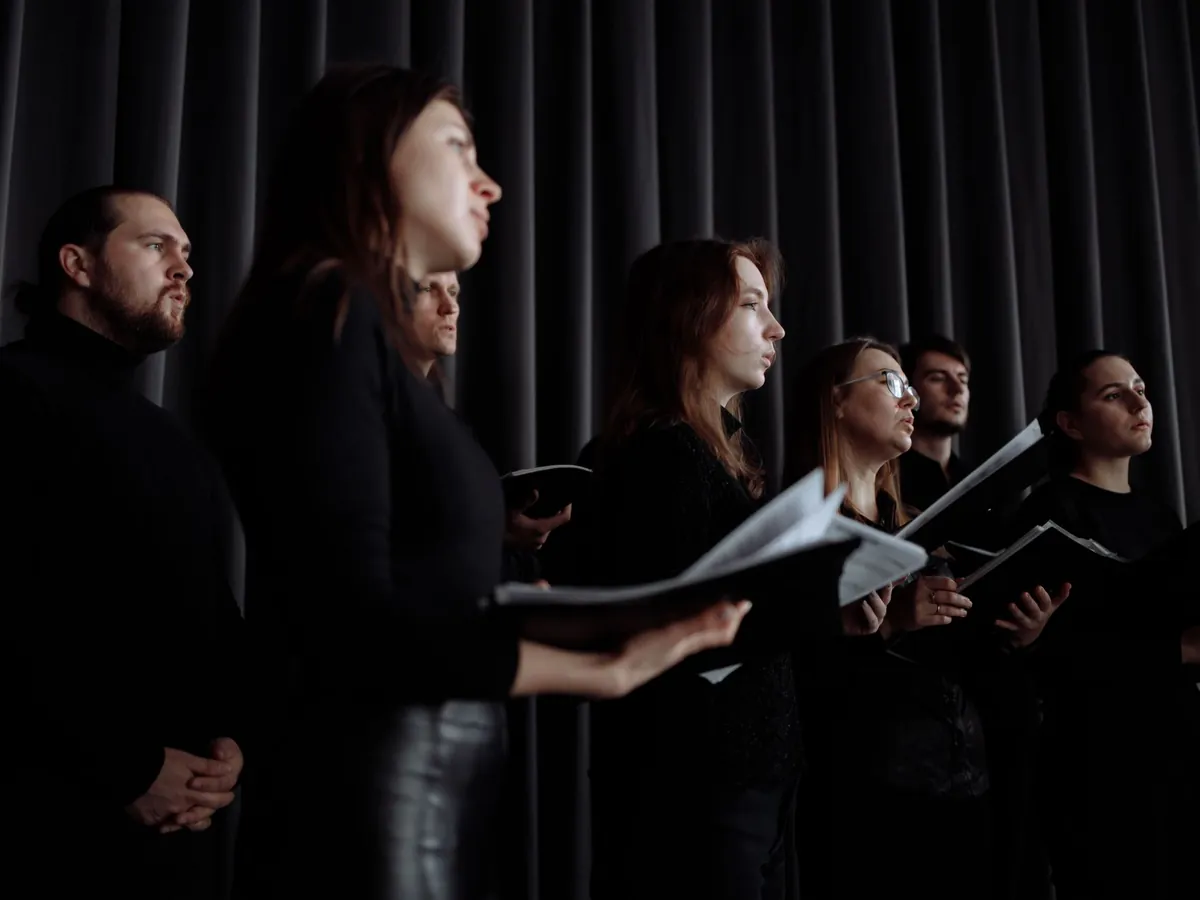
Mixed choir of men and women singing from their scores

Your voice type is more than your range

Range is the easiest part of a voice to measure, which is why every online voice type test starts there. On its own it's also the easiest to misread. Voice types overlap a lot: a tenor and a baritone may both reach G4, but one sings there comfortably all evening while the other is near the top of his voice. That's why voice teachers listen for a few things beyond your lowest and highest notes.

Treat your result as a starting point. If the test calls you a baritone but high notes feel easy and low ones feel heavy, you may be a tenor who has not built his top yet. The overlap percentages help here: a close second place is worth exploring with songs in both ranges, and the voice type guides describe how each type sounds.

  • Tessitura: the part of your range where you can sing for a long time without tiring. It usually sits in the middle of your range and says more about your voice type than your extreme notes do.
  • Timbre: the color of your voice. Brighter, lighter voices tend toward soprano and tenor; darker, heavier voices toward alto, baritone and bass.
  • Register breaks (passaggi): the notes where your voice shifts between chest and head voice, one of the most reliable clues. A tenor's upper break typically sits around F4–G4, a baritone's around D4–Eb4 and a bass's around Bb3–C4. Women's voices follow the same pattern, with sopranos shifting a little higher than mezzos and altos.
  • Weight and agility: how full the sound is and how easily it moves. Two sopranos with the same range can suit very different music.

Voice type tips for men, women and teens

Men: most adult men are baritones, so a baritone result is the most likely outcome, and true basses who can sustain an E2 are rare. If you flip into falsetto at the top, those notes still count toward your range, but they don't make you a tenor on their own. Tenors keep a full, connected sound up around G4 to A4.

Women: mezzo-soprano is the most common female voice type. Many women who mostly sing pop use chest voice and test lower than they would after some training, because head voice adds the top of the range. If your result says alto but you can float easily above C5 in head voice, take the test again and use that lighter sound for your highest notes.

Teens: voices change a lot during puberty. Boys' voices drop about an octave over a year or two, and girls' voices drop a few semitones. A result taken mid-change describes your voice today, not your adult voice type, so retest every few months, keep it comfortable, and stop if anything hurts or feels scratchy.

Adult voices keep changing slowly, too. Classical teachers often wait until a singer is in their twenties before settling on a voice type, and hormonal changes such as menopause can lower a voice later in life.
Last updated October 21, 2026

Use cases

Who uses the voice type test

From choir auditions to Friday-night karaoke, knowing your voice type makes singing easier.

Choir members

Find out whether you belong in the soprano, alto, tenor or bass section before an audition, or check that the part you've been given really suits you.

Self-taught singers

Know where your voice is strongest so you can pick exercises and songs that build your voice instead of straining it.

Voice teachers

Get a quick baseline of a new student's range in the first lesson, then retest every few months to show progress.

Karaoke and song picking

Choose songs that fit your range, or know how many semitones to transpose so the chorus lands where you sound best.

FAQ

Voice type test questions

Straight answers about voice types, ranges and how the test works.

Still have a question?

The quickest way to find out is to try it yourself. It only takes a minute.

Your voice type is the category your singing voice falls into: soprano, mezzo-soprano or alto for most women, and tenor, baritone or bass for most men. To find yours, sing from your lowest comfortable note to your highest. The test compares that range with each type and shows the closest match, plus how much you overlap the others. If you only want your range, the vocal range test does just that.

Find your voice type in a minute

One slow slide from your lowest note to your highest is all it takes. No sign-up, no download, and your audio never leaves your device.