Skip to content

Soprano Vocal Range Am I a Soprano?

See the soprano vocal range note by note, from middle C to high C, learn the soprano types and their roles, then sing into your mic to check how much of that range you cover. Free, no sign-up, right in your browser.

  • Reference range C4 – C6
  • Your soprano match in %
  • Audio stays on your device
Soprano range test
Loading the tool…

Quick reference

Soprano vocal range: notes, Hz and register shifts

The highest female voice type in numbers. The full range gets the headlines, but the comfortable middle and the register shifts say more about whether you are a soprano.

MeasureNotesFrequencyWhat it tells you
Typical soprano rangeC4 – C6 (middle C to high C)262 – 1,047 HzTwo octaves; trained voices often go higher
Comfortable tessituraAbout F4 – G5349 – 784 HzWhere a soprano can sing all evening
Lower register shiftAround Eb4 – E4311 – 330 HzChest voice hands over to middle voice
Upper register shiftAround F#5740 HzMiddle voice turns into head voice
Choir soprano partAbout C4 – G5 (A5)262 – 880 HzChoral lines sit lower than solo roles
Coloratura topUp to F6 and beyond1,397 Hz and upThe Queen of the Night's top note

Ranges are commonly cited classical figures in scientific pitch notation (C4 is middle C, A4 is 440 Hz). Register shifts follow the widely used placements for a lyric soprano and can sit a semitone or two away in your voice. Untrained sopranos usually cover a little less at both ends.

How it works

Am I a soprano? Check it in three steps

The soprano range test at the top of this page compares your voice with the soprano range, C4 to C6. Two minutes of warm-up first makes the result far more reliable.

  1. Step 1

    Warm up, then sing your whole range

    Hum, lip-trill or siren gently for two or three minutes. Press Start, pick free sing or the guided highest-then-lowest mode, and sing from a comfortable low note to your highest clean one, holding each note for about two seconds so it counts.

  2. Step 2

    Read your soprano match

    You get your lowest and highest steady notes with their frequencies, the share of the soprano range you cover, and how you overlap with mezzo-soprano, alto and the men's voice types. Quick squeaks show up as brief extremes but are not counted.

  3. Step 3

    Check where your voice feels easy

    Range alone cannot settle it. Sing a song whose chorus sits around D5 to G5. If it feels bright and easy for the whole song, and your notes below about A3 turn soft or breathy, soprano is a strong bet.

Quick reference

Types of soprano: soubrette, lyric, coloratura and dramatic

Opera houses sort sopranos by weight and agility, a system known as Fach. The ranges overlap; what changes is the size of the voice and the music it suits.

TypeSoundTypical topClassic roles
SoubretteLight, bright, youthfulAbout C6Despina, Zerlina, Adele
Lyric sopranoWarm, smooth, long linesAbout C6Mimì, Pamina, Micaëla, Liù
Coloratura sopranoAgile, sparkling, very highEb6 – F6Queen of the Night, Lucia, Olympia
Spinto sopranoLyric voice with extra punchAbout C6Tosca, Cio-Cio-San, Aida
Dramatic sopranoLarge, dark, rides an orchestraAbout C6Brünnhilde, Isolde, Turandot

Many sopranos move between neighboring types over a career, often from lyric toward spinto as the voice matures. Musical theater uses simpler labels, such as "legit soprano" for a light, classically produced sound.

Highlights

What a soprano voice sounds like

Three things separate a true soprano from a mezzo with a good top: the color of the voice, where it feels at home and where it changes gear.

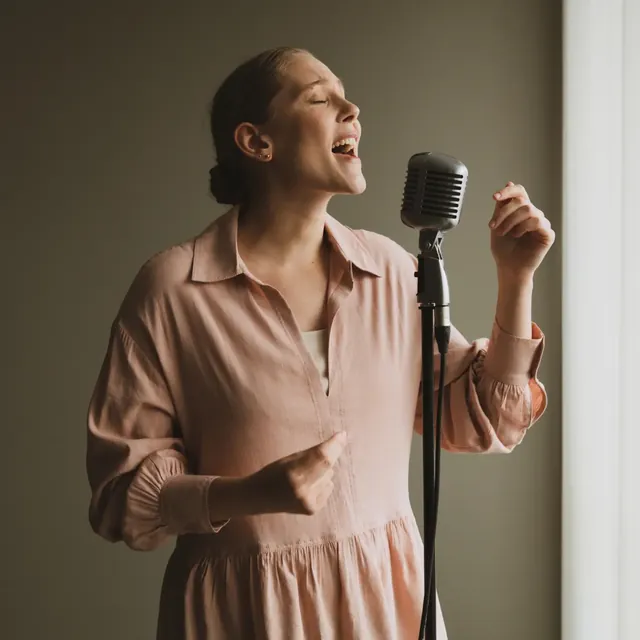
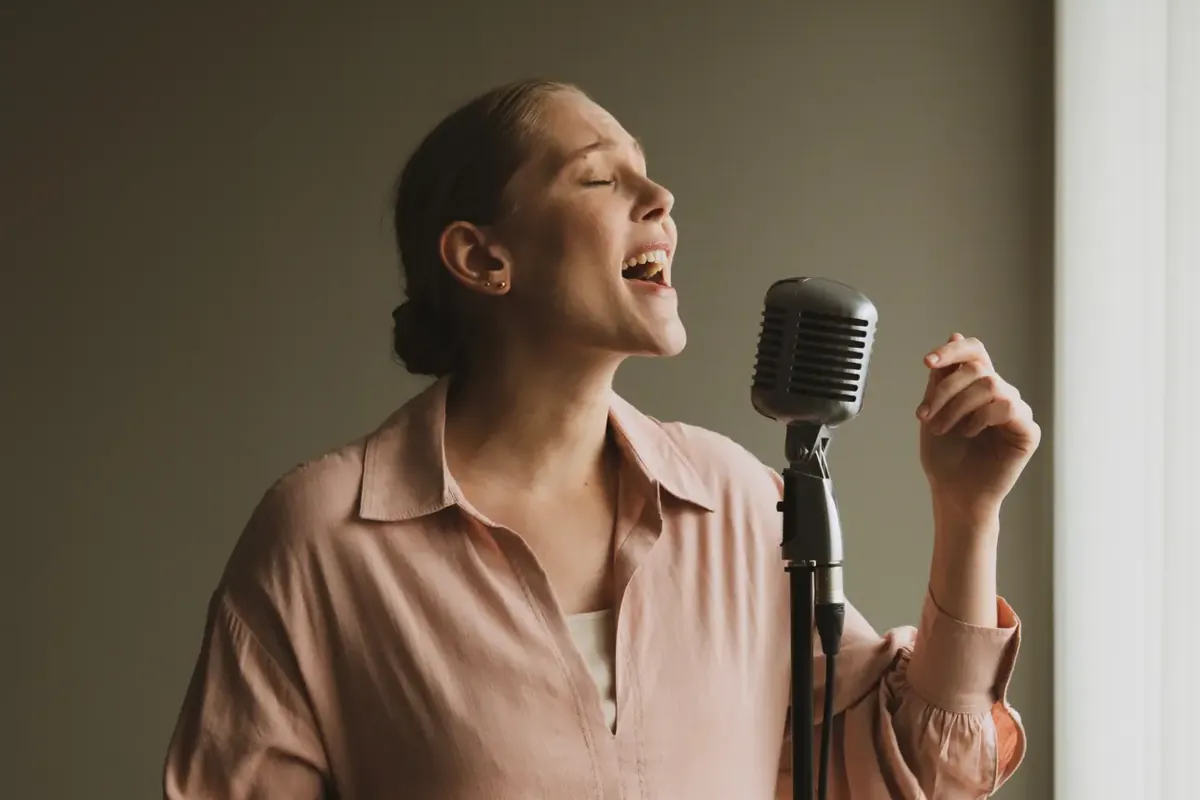
Soprano in a soft pink blouse singing with her eyes closed into a vintage microphone

A bright, ringing color

Soprano voices tend to sound light and clear, with a shine that carries over a choir or an orchestra without much push. Even on low notes the tone stays fairly bright rather than smoky. A darker, richer middle usually points toward mezzo-soprano instead.

At home high in the staff

A soprano's tessitura sits roughly between F4 and G5. Songs that hover around D5 to G5 feel like home, not like a climax. A mezzo can visit those notes too, but usually tires sooner and feels more settled about a third lower.

Register shifts that sit higher

A soprano's first shift, out of chest voice, comes early, around Eb4 to E4. The second, into head voice, sits around F#5, roughly a whole step above a mezzo's. Notes just below it stay easy instead of getting heavy and loud.

Singer in a floral qipao singing into a gold vintage microphone in front of a red curtain

Famous soprano roles, singers and songs

In opera the soprano usually sings the heroine: Mimì in La bohème, Violetta in La traviata, Pamina in The Magic Flute, Tosca and Madama Butterfly. Coloratura sopranos get the fireworks, from the Queen of the Night's F6 to Lucia's mad scene. Singers widely held up as models include Joan Sutherland for coloratura, Renée Fleming and Kiri Te Kanawa for lyric roles, Leontyne Price for spinto repertoire and Birgit Nilsson for Wagner.

Musical theater has its own soprano tradition, often called legit soprano. Julie Andrews is the classic example, and Christine in The Phantom of the Opera, Cosette in Les Misérables, Glinda in Wicked and Johanna in Sweeney Todd are all soprano roles. In pop the labels are looser: Ariana Grande and Dolly Parton are commonly described as sopranos, while many pop stars with high, belted choruses are mezzo-sopranos with a strong mix.

Your test result lists singers whose published ranges overlap yours. Use it as a pointer for song choices, not a diagnosis: a famous singer's lowest growl or highest whistle note says little about where their voice sits most of the time.
How to train a soprano voice

Soprano training is mostly about keeping the top free while building a middle that isn't breathy. Five to ten minutes of lip trills or sirens on 'ng', from your lowest note to your highest, warms the whole range and smooths both register shifts. Then practice slow scales that cross F#5 on 'oo' or 'ee' at a medium volume, and read our guide on how to sing higher if the top feels tight.

Many young sopranos have a weak, airy patch below the first shift, roughly A3 to D4. Don't force chest voice down there; speak short phrases on pitch and then sing them, so the tone finds its focus. Above the staff, let vowels shift slightly, a bright 'ee' toward 'ih' and a wide 'ah' toward 'uh', instead of clamping the jaw. That small vowel change is what keeps high notes round.

  • Warm up from the middle out: start around A4, then extend down and up. Never begin a session on your top notes.
  • Track your top note: retest every few weeks with the highest note test and count only notes you can hold for two seconds.
  • Practice high notes quietly too: high notes are naturally loud. Singing them softly is a good sign that the voice is free, not pushed.
  • Stop when it scratches: hoarseness or pain means rest for the day. A teacher can spot pressed habits before they become a problem.

Last updated October 21, 2026

Use cases

Music that suits a soprano voice

Where a soprano voice sounds its best, from the Sunday choir to Saturday karaoke.

Choir soprano line

You usually carry the melody. Soprano 1 takes the highest notes; soprano 2 sits a little lower and often harmonizes with the altos.

Opera and art song

Mozart, Handel and Puccini arias and art songs by Schubert or Fauré sit right in the soprano tessitura.

Legit musical theater

Golden Age shows and roles like Christine, Cosette and Glinda reward a clear, floated head voice.

Pop, folk and worship

Look for songs whose chorus lives around C5 to E5, and use the keys your result suggests so the melody stays inside your notes.

FAQ

Soprano questions, answered

Quick answers about the soprano range, soprano types and the test.

Still have a question?

The quickest way to find out is to try it yourself. It only takes a minute.

The soprano vocal range is usually given as C4 to C6, from middle C to high C, or about 262 to 1,047 Hz. Choir soprano parts mostly stay between C4 and G5 or A5, while coloratura sopranos in opera reach Eb6 to F6. Untrained sopranos often cover a little less at both ends.

Check your soprano range in a minute

Sing low to high once and see how much of the soprano range, C4 to C6, your voice covers. Free, no sign-up, and your audio never leaves your device.